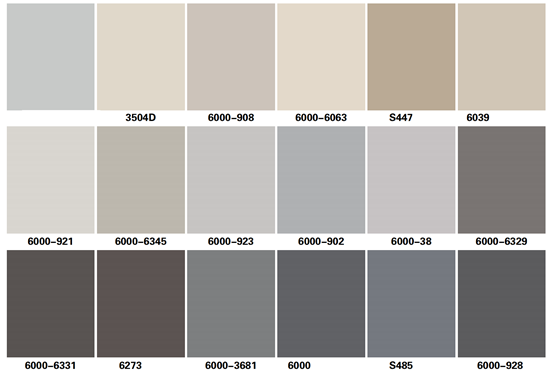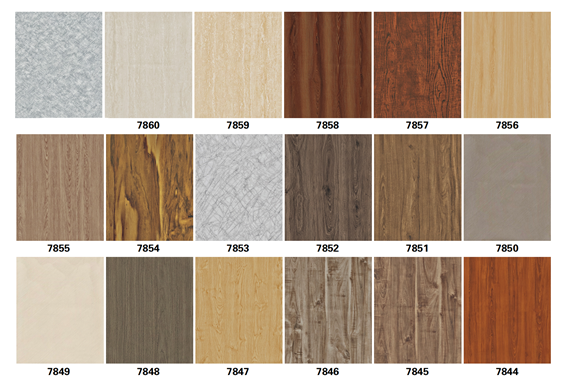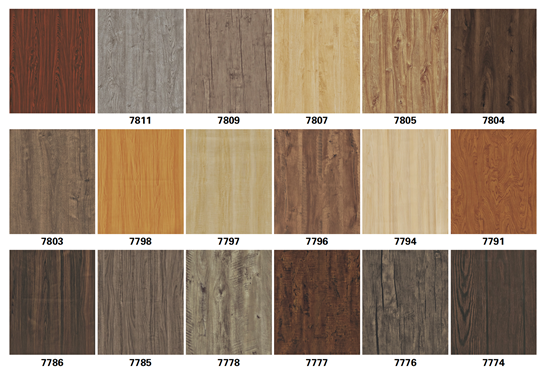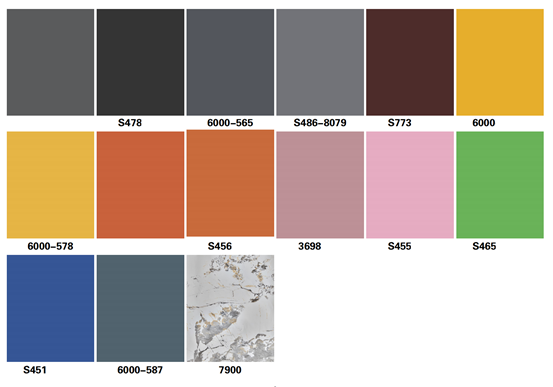
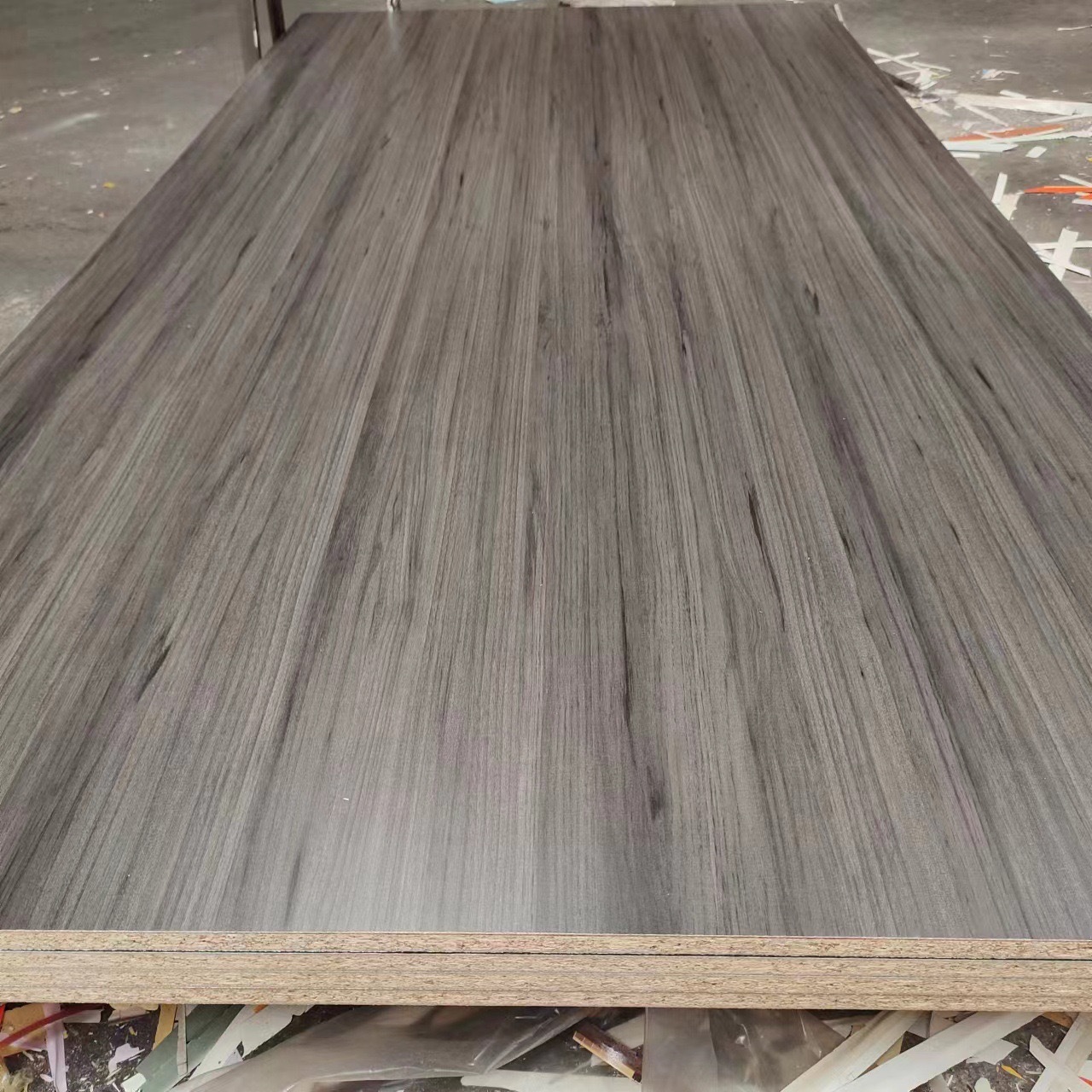
Melamine-Faced Particleboard, full name Melamine-Faced Particleboard, is a decorative board made of particleboard as the base material. The particleboard is produced by using wood particles (wood processing scraps such as poplar, pine, eucalyptus, etc.) as raw materials, adding environmentally friendly adhesives such as melamine resin or urea-formaldehyde resin, and then undergoing drying, glue mixing, paving, and high-temperature and high-pressure pressing. The surface is covered with melamine-impregnated decorative paper and compounded by secondary hot pressing. It combines the economy of particleboard with the weather resistance and aesthetic characteristics of melamine finish, does not require additional painting, is easy to process and cost-effective. It is an economical and environmentally friendly board widely used in furniture manufacturing, interior decoration, commercial display and other fields, suitable for cross-border export, and meets international building materials environmental protection and quality standards.
- Product Structure
Base Material: Wood particles are the core raw materials, selected from wood processing scraps such as poplar, pine, and eucalyptus. It is made by crushing, drying (moisture content controlled at 8%-12%), glue mixing (adding melamine glue or urea-formaldehyde glue), layered paving (fine particles on the surface layer and coarse particles in the middle layer), and high-temperature and high-pressure pressing. It has a uniform texture, no obvious knots or wormholes, a compact structure, stable load-bearing performance, makes full use of wood resources, and is more environmentally friendly and energy-saving.
Decorative Layer: Adopts melamine-impregnated decorative paper made by high-precision printing technology, which can simulate various patterns such as natural wood grain, stone grain, solid color, and cloth grain, with full color, clear texture, and uniform and long-lasting color. It is closely attached to the base material under high temperature and high pressure, with strong adhesion, not easy to fall off or fade. It can provide various surface effects such as matte, bright, skin-friendly, and wood grain embossment to meet the needs of different decorative styles.
Protective Layer: The surface of the finish is equipped with a melamine resin curing layer, which does not require additional painting or waxing. It naturally has good wear resistance, scratch resistance, acid and alkali resistance, and moisture resistance, which can effectively resist slight wear and stain erosion in daily use. At the same time, it can further reduce the formaldehyde emission of the base material and improve the overall environmental protection of the board.
- Specification Parameters
Standard Size: The regular size is 2440mm×1220mm. Special sizes such as 1830mm×915mm and 1250×2500mm can be customized according to customer needs, which is suitable for construction and export packaging needs in different scenarios.
Thickness: Regular thickness includes 3mm, 5mm, 8mm, 10mm, 12mm, 15mm, 18mm, 25mm. Special thickness within the range of 2mm-30mm can be customized, and the thickness tolerance is controlled at ±0.2mm/m, which meets the needs of different load-bearing, decoration and processing.
Density: The regular density is 600-750kg/m³, with uniform texture. The surface density is slightly higher than the middle layer, which balances flatness and load-bearing performance. High-density (750-800kg/m³) or low-density (500-600kg/m³) products can be customized according to needs.
Environmental Protection Level: The regular level is E1 (formaldehyde emission ≤0.124mg/m³), and E0 level (formaldehyde emission ≤0.050mg/m³) can be customized. Some products can meet international environmental protection standards such as CARB P2 and TSCA Title VI, and have passed certifications such as FSC and CE, suitable for long-term indoor use and cross-border export requirements.
Adhesive Type: The mainstream uses melamine glue and urea-formaldehyde glue. Waterproof glue (WBP) can be selected according to needs to improve the moisture resistance of the board and adapt to use in humid environments.
- Core Features
Economical and Practical, High Cost-Effectiveness: Using wood processing scraps as raw materials, the raw material cost is low, and the overall cost is much lower than that of solid wood boards and plywood. It has both decorativeness and practicality, and is the preferred economical material in the furniture and decoration industry. At the same time, it reduces wood resource waste and conforms to the concept of environmental protection and sustainability.
Excellent Decorativeness, Convenient Construction: There are various decorative patterns, which can accurately restore natural wood grain and stone texture. The surface is smooth and delicate, no additional processes such as painting and waxing are required, and the beautiful effect can be presented after construction, saving construction cost and time, and suitable for mass production and on-site construction.
Uniform Texture, Good Processability: The base material has no obvious grain direction and uniform texture, which can be easily sawed, nailed, glued, milled, drilled and other processing, not easy to edge chipping and cracking. It can be edge-sealed, CNC shaped and other treatments, suitable for complex shape design, with high processing efficiency and no need for complex equipment.
Weather Resistant, Durable and Easy to Clean: The melamine finish has excellent wear resistance, scratch resistance, acid and alkali resistance, and moisture resistance. It can resist slight impact and stains in daily use, is not easy to fade or peel off. It can be cleaned with a damp cloth in daily use without special maintenance, has a long service life, and is suitable for high-frequency use scenarios.
Environmental Protection Compliance, Suitable for Export: Adopts environmentally friendly adhesive with low formaldehyde emission, which meets domestic and foreign indoor environmental protection standards and cross-border export requirements. Relevant environmental protection certification reports can be provided, which is suitable for building materials import standards in many countries and regions around the world.
- Application Scenarios
Furniture Manufacturing: It is mainly used for the cabinets, door panels and partitions of wardrobes, cabinets, desks, TV cabinets, bedside cabinets, shoe cabinets, bookcases and other furniture. It can be processed into different shapes according to design needs, which has both beauty and practicality, and is the mainstream economical board for household and office furniture production.
Interior Decoration: Suitable for wall decorative panels, ceiling panels, background walls, partitions, door and window casings, skirting lines, etc. It can be directly paved or spliced to create a simple and elegant indoor atmosphere, suitable for various decoration styles such as modern simplicity, Nordic style and light luxury, and suitable for indoor spaces such as residences, office buildings and apartments.
Commercial Spaces: Used for shopping mall display cabinets, shelves, cash registers, display boards, as well as wall and partition decoration of hotels, restaurants and convenience stores. It is wear-resistant and easy to clean, and can customize decorative patterns according to brand style to improve the space grade, suitable for high-frequency use commercial scenarios.
Other Fields: It can be used in packaging materials, speaker enclosures, toys, crafts, booth construction and other fields. It uses its characteristics of uniform texture, convenient processing and high cost-effectiveness to meet the needs of different scenarios. At the same time, it can be used as cross-border export building materials to adapt to the international market.